How I use AI-assisted investigation, implementation, and verification in my practice, and what agentic coding is changing across software development.
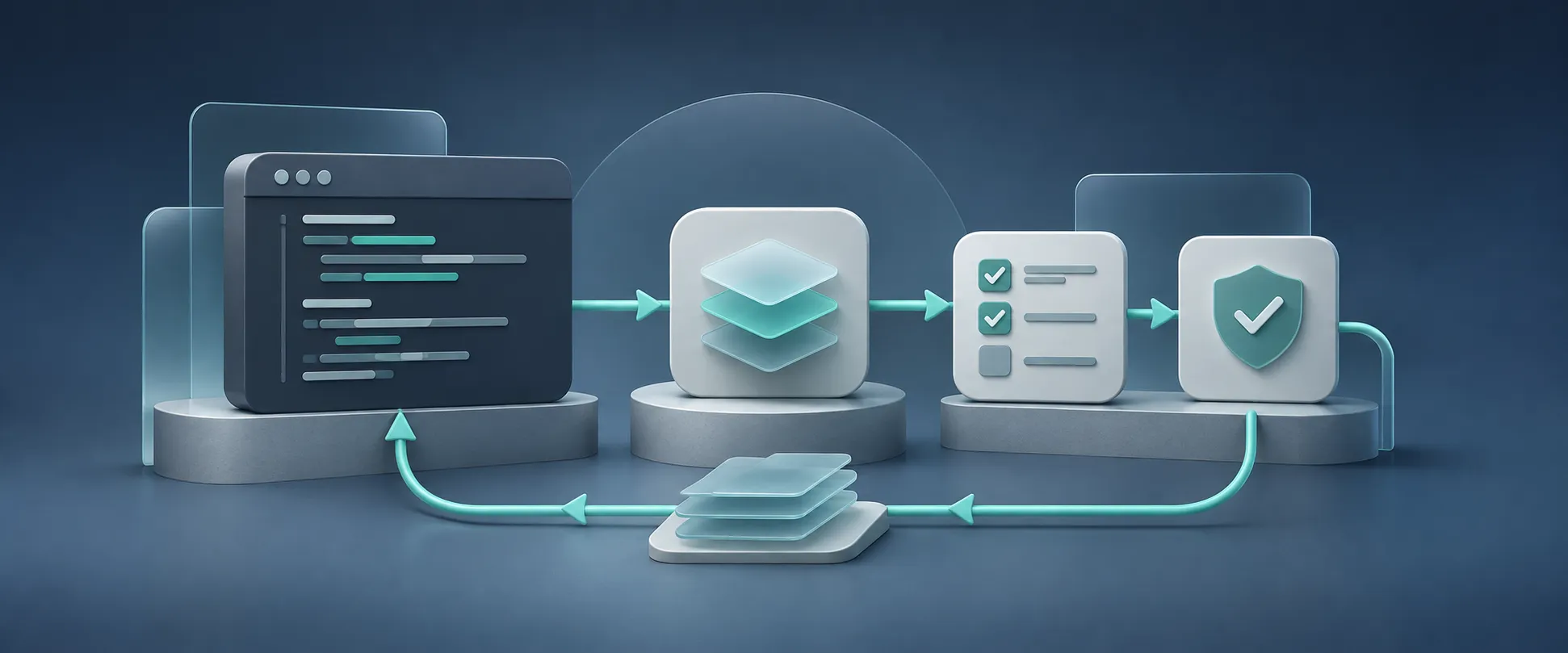
Conceptual illustration · Agentic AI Coding
Coding agents
Repository analysis
Build checks
Human review
Understand the subject
What is agentic AI coding?
Agentic AI coding uses an AI system that can work through a sequence of development actions: inspect a repository, reason about a task, propose or make edits, run permitted commands, and use the results to revise its next step. Its usefulness comes from that working loop, beyond producing a standalone code suggestion.
A developer still needs to define the goal, provide relevant context, set the scope of access, and decide whether the result is appropriate. The agent’s tools and permissions determine what it can inspect or change. Tests and build output provide evidence about the work, but neither removes the need to assess the requirements and review the changes.
I have embraced AI as part of my practice because I want to keep improving how I build software. It helps me explore implementation options, work through repetitive changes, and bring ideas into a form I can inspect and refine. I pair those capabilities with my engineering experience and a clear definition of the result the business needs.
Benefits & impact
Why it matters to the business.
Shorten repetitive implementation cycles
An agent can help apply a bounded pattern across related files, connect a page to its data, or prepare an implementation for local review. Clear instructions and an existing codebase give that work useful constraints.
Business impactPotential time savings can create more room for product decisions and refinement. I assess the complete task, including prompting, waiting, review, and rework, instead of treating generated code as delivered value.
Make investigation and checking easier to repeat
Agents can assist with tracing related code, identifying callers, drafting checks, and running the commands selected for the change. A concrete input and expected result make the work easier to inspect.
Business impactUsed carefully, this can support more consistent verification and help surface omissions. An agent can also misunderstand the system or write checks that merely agree with its own implementation, so independent review matters.
Explore more options before settling on a product
AI assistance makes it practical to draft alternatives and review them in a working environment. The developer can compare the result against the product’s audience, business requirements, and existing architecture.
Business impactMy aim is better products through more informed iteration. The benefit comes from choosing and refining the right implementation, with understandable code and support requirements.
Make the right choice
When to use it.
When it is a good fit
Bounded tasks with a clear acceptance condition
Repository investigation, a defined feature, a targeted fix, or a consistent set of changes can work well when the expected behavior is explicit and the result can be inspected.
An existing codebase with useful feedback
Project conventions, representative data, meaningful tests, build checks, and a local preview give the agent and developer signals to work with. Better context reduces the need to guess.
A developer prepared to direct and review
The workflow is most useful when someone understands the product and can challenge a plausible answer. It rewards learning how the tools behave and adapting the process as their capabilities change.
Tradeoffs and responsibilities
More code can create more review work
A plausible implementation can still have incorrect assumptions, weak validation, dependency problems, or unnecessary complexity. Keep the change small enough to review and evaluate it against the original need.
Access should match the task
Use appropriate repository and environment access, protect secrets and customer information, and keep publication or production actions under the project’s normal controls. An agent’s ability to act is not a reason to give it every permission.
Measure the result, not the feeling of speed
Consider review time, defects, rework, maintainability, and whether the feature was accepted. Model benchmarks, code volume, and personal impressions answer different questions from business outcomes.
Industry impact
How agentic coding is changing the work.
Agentic tools are changing where effort is spent: defining tasks, supplying context, reviewing changes, and validating behavior become more visible parts of delivery. Industry reports show adoption, but the evidence does not support one universal productivity multiplier. The findings below describe different tools, dates, populations, and measures.
Agents are becoming part of everyday development
GitHub’s 2026 Octoverse report documents rising agent participation in pull requests and substantial growth in platform activity. This is evidence about workflows on GitHub; more commits or pull requests alone do not establish better software or prove that AI caused the growth.
Anthropic’s June 2026 analysis of Claude Code sessions describes people making much of the planning decisions while the agent handles much of the execution. It is vendor research about one tool’s users, not a controlled measurement of every developer or a forecast that engineering judgment is becoming unnecessary.
METR’s early-2025 randomized study found that 16 experienced open-source developers took 19% longer with the tools studied on 246 tasks. Its February 2026 follow-up reported indications of improvement with newer tools, but warned that selection effects made the current estimate unreliable. The lesson is to test the workflow in its actual setting rather than generalize either result to all coding work.
Software work includes understanding an existing system, making coordinated changes, and checking that the result fits the business. Writing the first version of a function or page is one part of that responsibility.
I have embraced AI to help with that process. It can take on investigation and repetitive implementation tasks while I guide the requirements and evaluate the result. Thinking ahead means learning how to use new tools well and improving the delivery process as those tools develop.
The approach
How I approached the work.
01
Start with the product need
I describe the intended behavior, the audience, and the constraints before asking an agent to make a change. During this website work, clarifying what belonged under Portfolio and Case Studies determined the implementation.
02
Use the repository as context
The agent can inspect existing layouts, data, styles, and navigation behavior. Working with those conventions helps keep a change connected to the rest of the site.
03
Bring the result into a reviewable form
A local preview, an inspectable change, and relevant checks give me something concrete to evaluate. I can then adjust the content, interaction, or scope against the original intent.
04
Keep learning and refining the process
I see adopting AI as an ongoing part of improving my practice. I want the tools to help me build clearer, more useful products, while maintaining responsibility for what is delivered and how it will be supported.
What this means for your project
Use AI to strengthen the engineering process.
My aim is to make room for better decisions and more useful iteration by reducing repetitive effort. The value comes from combining the tools with experience, a clear product goal, and verification that addresses the real behavior being changed.